
Buying motor insurance is an important responsibility for every vehicle owner. But do you always know what your policy covers, what it does not cover, and how much you are paying for each type of protection?
To make things clearer, the Insurance Regulatory and Development Authority of India (IRDAI) has introduced a new four-layer structure for motor insurance policies covering private cars and two-wheelers. These new motor insurance rules will come into effect from 15 December 2026.
The main purpose of this change is to help vehicle owners understand their insurance options and choose coverage according to their requirements. Instead of looking at motor insurance as one combined package, customers will be able to see four separate
sections covering different types of risks.
But what exactly is changing? Are all four covers compulsory? Can existing policyholders make changes to their insurance?
Let’s understand everything in simple words.
What Are the New Motor Insurance Rules in 2026?
Under the new IRDAI framework, motor insurance policies for private cars and two-wheelers will be divided into four clearly defined sections:
- Third-party liability cover
- Legal liability towards occupants or pillion riders
- Personal accident cover
- Own-damage cover
Not all these sections are compulsory. Some are mandatory, while others are optional, allowing customers to select additional protection according to their needs.
IRDAI has also directed general insurers to follow standardised policy wordings and provide a customer option form and a Customer Information Sheet (CIS).
The new framework follows directions from the Supreme Court in the case of National Insurance Company Ltd. vs Smt. Thungala Dhana Laxmi & Others.
Understanding the Four Layers of Motor Insurance
Let’s look at each section and understand what protection it offers.
1. Third-Party Liability Cover (Mandatory)
- Third-party insurance is compulsory for vehicle owners under Indian motor vehicle law.
- This cover protects you against legal liability if your vehicle causes injury, death or property damage to another person in an accident.
- For example: Imagine your car accidentally hits another vehicle and damages it. The third-party insurance section can cover your legal liability for the damage, subject to the applicable policy terms and limits.
- Remember, third-party insurance does not cover damage to your own vehicle.
2. Legal Liability Towards Occupants or Pillion Riders (Optional)
- This section covers the vehicle owner’s legal liability towards people travelling in the insured vehicle.
- For cars, it relates to occupants or passengers. For two-wheelers, it covers the pillion rider. It can also include employees of the insured, as specified in the policy.
- For example: If you are responsible for an accident in which a passenger travelling in your car suffers an injury, this cover may protect your legal liability towards that passenger, subject to the policy conditions.
- This section is optional and can be selected by paying an additional premium.
- It is important to understand that this is a legal liability cover. It should not be confused with personal accident insurance, which is a separate section.
3. Personal Accident Cover (Mandatory and Optional Components)
- Personal accident protection is another important part of the new structure.
- It has two components:
- Mandatory: Personal accident cover for the owner-insured, as applicable under existing rules.
- Optional: Additional personal accident cover for occupants, pillion riders and drivers other than the owner-driver.
- This distinction matters because legal liability towards passengers and personal accident protection are not the same thing.
- The first deals with the vehicle owner’s legal liability, while the second provides personal accident protection to eligible individuals under the selected policy terms.
4. Own-Damage Cover (Optional)
- Own-damage insurance protects your vehicle against covered loss or damage.
- This can include damage caused by accidents, fire, theft, natural calamities and other insured events, depending on the policy.
- For example: Suppose your car gets damaged in an accident. If you have selected own-damage cover, the repair expenses may be covered according to your policy terms, deductibles and exclusions.
- Unlike third-party insurance, own-damage protection is optional. However, it can be an important consideration for people who want financial protection for their own vehicles.
Mandatory vs Optional Motor Insurance Covers: What’s the Difference?
Here is a quick comparison to help you understand the new structure.
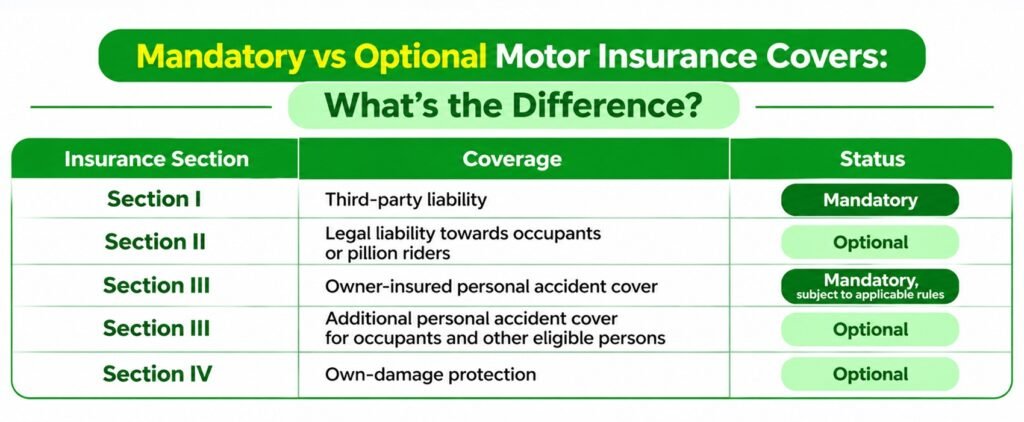
This means customers will have more clarity about the protection they are purchasing rather than assuming that every type of coverage is automatically included.
What Changes for Existing Motor Insurance Policyholders?
One useful feature of the new framework is that existing policyholders can also add occupant or pillion rider legal liability cover during their current policy period.
Here is how it works:
- You can request Section II coverage from your existing third-party insurance provider.
- You will need to pay an additional premium.
- The insurer will issue an endorsement confirming the additional coverage.
- The new protection will begin from the date and time mentioned in that endorsement.
An important point: You do not need to cancel your existing third-party motor insurance policy to add this cover.
However, this option must be exercised with the insurer that issued your existing third-party insurance policy.
What Are the Customer Option Form and Customer Information Sheet?
IRDAI has introduced two important requirements to make motor insurance purchases more transparent.
1. Customer Option Form
- Insurers must provide a form explaining the four sections of motor insurance.
- Customers can select their preferred coverage by ticking the relevant options, whether they purchase insurance online or offline.
- The completed option form will also form part of the insurance policy.
2. Customer Information Sheet (CIS)
- The Customer Information Sheet will help customers understand the coverage offered under their policy.
- Insurers must also clearly mention the actual coverage and premium charged against each section in the policy schedule.
- This means customers will be able to understand how much they are paying for different types of protection instead of seeing only one combined premium amount.


